អនុគមន៍អ៊ីពែបូលីកច្រាស់

ដោយវិគីភីឌា
អនុគមន៍ artanh

អនុគមន៍ច្រាស់នៃអនុគមន៍អ៊ីពែបូលីកគឺជាអនុគមន៍អ៊ីពែបូលីកក្រលាផ្ទៃ។ វាគណនាក្រលាផ្ទៃនៃបំណែករបស់អ៊ីពែបូលឯកតា  x^2 - y^2 = 1 \, ដែលជាវិធីដូចគ្នាចំពោះអនុគមន៍ត្រីកោណមាត្រច្រាស់ ក្នុងការគណនាប្រវែងធ្នូនៃបំណែកមួយនៅលើរង្វង់ឯកតា x^2 + y^2 = 1 \,។ នៅក្នុងគណិតវិទ្យា ជាទូទៅវាត្រូវបានគេសរសេរកាត់ជា arsinh, arcsinh \,asinh \, (នៅក្នុងជំនាញវិទ្យាសាស្ត្រកុំព្យូទ័រ)។ sinh^{-1} (x), cosh^{-1} (x) \, ជាដើមក៏ត្រូវបានគេប្រើប្រាស់ផងដែរ។


មាតិកា

[កែប្រែ] តំណាងលោការីត

សញ្ញានៃប្រមាណវិធីត្រូវបានផ្តល់និយមន័យនៅក្នុងប្លង់កុំផ្លិចដោយ៖

  • \operatorname{arsinh}\, x = \ln(x + \sqrt{x^2 + 1})
  • \operatorname{arcosh}\, x = \ln(x + \sqrt{x-1}\sqrt{x+1})
  • \operatorname{artanh}\, x = \ln\left(\frac{\sqrt{1 - x^2}}{1-x}\right)
                                 = \frac{1}{2} \ln\left(\frac{1+x}{1-x}\right)
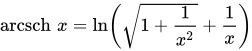
  • \operatorname{arcsch}\, x = \ln\left(\sqrt{1+\frac{1}{x^2}}+\frac{1}{x}\right)
  • \operatorname{arsech}\, x = \ln\left(\sqrt{\frac{1}{x}-1}\sqrt{\frac{1}{x}+1}+\frac{1}{x}\right)
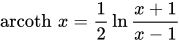
  • \operatorname{arcoth}\, x = \frac{1}{2} \ln\frac{x+1}{x-1}


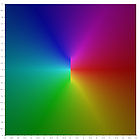
អនុគមន៍អ៊ីពែបូលីកច្រាស់ក្នុងប្លង់កុំផ្លិច
Complex ArcSinh.jpg
Complex ArcCosh.jpg
Complex ArcTanh.jpg
Complex ArcCoth.jpg
Complex ArcSech.jpg
Complex ArcCsch.jpg

\operatorname{arsinh}(z)

\operatorname{arcosh}(z)

\operatorname{artanh}(z)

\operatorname{arcoth}(z)

\operatorname{arsech}(z)

\operatorname{arcsch}(z)

[កែប្រែ] កន្សោមស៊េរី

កន្សោមស៊េរីអាចទទួលបានចំពោះអនុគមន៍ខាងលើ៖

\operatorname{arsinh}\, x
= x - \left( \frac {1} {2} \right) \frac {x^3} {3} + \left( \frac {1 \cdot 3} {2 \cdot 4} \right) \frac {x^5} {5} - \left( \frac {1 \cdot 3 \cdot 5} {2 \cdot 4 \cdot 6} \right) \frac {x^7} {7} +\cdots
= \sum_{n=0}^\infty \left( \frac {(-1)^n(2n)!} {2^{2n}(n!)^2} \right) \frac {x^{2n+1}} {(2n+1)} , \qquad \left| x \right| < 1
\operatorname{arcosh}\, x
= \ln 2x - \left( \left( \frac {1} {2} \right) \frac {x^{-2}} {2} + \left( \frac {1 \cdot 3} {2 \cdot 4} \right) \frac {x^{-4}} {4} + \left( \frac {1 \cdot 3 \cdot 5} {2 \cdot 4 \cdot 6} \right) \frac {x^{-6}} {6} +\cdots \right)
= \ln 2x - \sum_{n=1}^\infty \left( \frac {(-1)^n(2n)!} {2^{2n}(n!)^2} \right) \frac {x^{-2n}} {(2n)} , \qquad x > 1
\operatorname{artanh}\, x = x + \frac {x^3} {3} + \frac {x^5} {5} + \frac {x^7} {7} +\cdots = \sum_{n=0}^\infty \frac {x^{2n+1}} {(2n+1)} , \qquad \left| x \right| < 1
\operatorname{arcsch}\, x = \operatorname{arsinh}\, x^{-1}
= x^{-1} - \left( \frac {1} {2} \right) \frac {x^{-3}} {3} + \left( \frac {1 \cdot 3} {2 \cdot 4} \right) \frac {x^{-5}} {5} - \left( \frac {1 \cdot 3 \cdot 5} {2 \cdot 4 \cdot 6} \right) \frac {x^{-7}} {7} +\cdots
= \sum_{n=0}^\infty \left( \frac {(-1)^n(2n)!} {2^{2n}(n!)^2} \right) \frac {x^{-(2n+1)}} {(2n+1)} , \qquad \left| x \right| < 1
\operatorname{arsech}\, x = \operatorname{arcosh}\, x^{-1}
= \ln \frac{2}{x} - \left( \left( \frac {1} {2} \right) \frac {x^{2}} {2} + \left( \frac {1 \cdot 3} {2 \cdot 4} \right) \frac {x^{4}} {4} + \left( \frac {1 \cdot 3 \cdot 5} {2 \cdot 4 \cdot 6} \right) \frac {x^{6}} {6} +\cdots \right)
= \ln \frac{2}{x} - \sum_{n=1}^\infty \left( \frac {(-1)^n(2n)!} {2^{2n}(n!)^2} \right) \frac {x^{2n}} {2n} , \qquad 0 < x \le 1
\operatorname{arcoth}\, x = \operatorname{artanh}\, x^{-1}
= x^{-1} + \frac {x^{-3}} {3} + \frac {x^{-5}} {5} + \frac {x^{-7}} {7} +\cdots
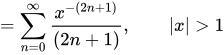
= \sum_{n=0}^\infty \frac {x^{-(2n+1)}} {(2n+1)} , \qquad \left| x \right| > 1

កន្សោមអាស៊ីមតូចចំពោះ arsinh x គឺ

\operatorname{arsinh}\, x = \ln 2x + \sum\limits_{n = 1}^\infty  {\left( { - 1} \right)^{n - 1} \frac{{\left( {2n - 1} \right)!!}}{{2n\left( {2n} \right)!!}}} \frac{1}{{x^{2n} }}

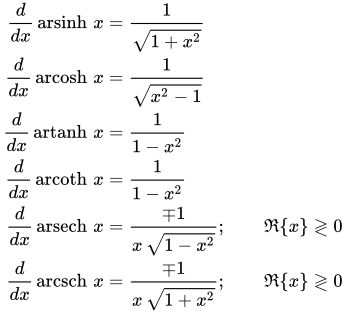
[កែប្រែ] ដេរីវេនៃអនុគមន៍អ៊ីពែបូលីកច្រាស់


\begin{align}
\frac{d}{dx} \operatorname{arsinh}\, x & {}= \frac{1}{\sqrt{1+x^2}}\\
\frac{d}{dx} \operatorname{arcosh}\, x & {}= \frac{1}{\sqrt{x^2-1}}\\
\frac{d}{dx} \operatorname{artanh}\, x & {}= \frac{1}{1-x^2}\\
\frac{d}{dx} \operatorname{arcoth}\, x & {}= \frac{1}{1-x^2}\\
\frac{d}{dx} \operatorname{arsech}\, x & {}= \frac{\mp 1}{x\,\sqrt{1-x^2}}; \qquad \Re\{x\} \gtrless 0\\
\frac{d}{dx} \operatorname{arcsch}\, x & {}= \frac{\mp 1}{x\,\sqrt{1+x^2}}; \qquad \Re\{x\} \gtrless 0
\end{align}

ឧទាហរណ៍មួយចំពោះដេរីវេ។ តាង \theta = arsinh x \, គេបានៈ

\frac{d\,\operatorname{arsinh}\, x}{dx} = \frac{d \theta}{d \sinh \theta} = \frac{1} {\cosh \theta} = \frac{1} {\sqrt{1+\sinh^2 \theta}} = \frac{1}{\sqrt{1+x^2}}


[កែប្រែ] សូមមើលផងដែរ

ឧបករណ៍ផ្ទាល់ខ្លួន

អថេរ
សកម្មភាព​
ទិសដៅ
សហគមន៍
បោះពុម្ព​/នាំចេញ​
ប្រអប់​ឧបករណ៍
ជាភាសាដទៃទៀត