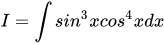
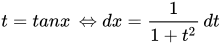
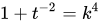
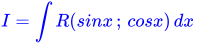
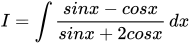
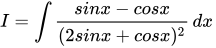
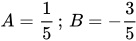
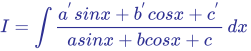
អាំងតេក្រាល (បារាំង: Intégral ; អង់គ្លេស : Integral ) ហៅជា អនុកល [ ១] ក៏បាន គឺជាគន្លឹះដ៏សំខាន់នៅក្នុងគណិតវិទ្យា ។ បើនិយាយឱ្យស្រួលស្តាប់ទៅ អាំងតេក្រាល គឺជាអនុគមន៍មុនពេលធ្វើដេរីវេ ។
រូបមន្តអាំងតេក្រាលមិនកំណត់មួយចំនួន [ កែប្រែ ]
C ជាចំនួនពិត
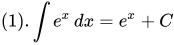
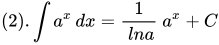
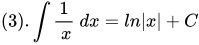
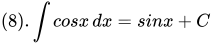
រូបមន្តអាំងតេក្រាលមិនកំនត់សំខាន់ៗ
(
1
)
.
∫
e
x
d
x
=
e
x
+
C
{\displaystyle (1).\int e^{x}\,dx\,\!=e^{x}+C}
(
2
)
.
∫
a
x
d
x
=
1
l
n
a
a
x
+
C
{\displaystyle (2).\int a^{x}\,dx\,\!={\frac {1}{\ lna}}~a^{x}+C}
(
3
)
.
∫
1
x
d
x
=
l
n
|
x
|
+
C
{\displaystyle (3).\int {\frac {1}{\ x}}~dx=ln|x|+C}
(
4
)
.
∫
x
p
d
x
=
1
p
+
1
x
p
+
1
+
C
(
{\displaystyle (4).\int x^{p}\,dx\,\!={\frac {1}{\ p+1}}x^{p+1}+C\quad (}
ដែល p ជាចំនួនពិត)
(
5
)
.
∫
1
x
2
−
a
2
d
x
=
1
2
a
l
n
|
x
2
−
a
2
x
2
+
a
2
|
+
C
(
a
≠
0
)
{\displaystyle (5).\int {\frac {1}{\ {x^{2}-a^{2}}}}\,dx\,\!={\frac {1}{\ {2a}}}ln|{\frac {x^{2}-a^{2}}{x^{2}+a^{2}}}|+C\quad (a\neq 0)}
(
6
)
.
∫
1
x
2
+
a
2
d
x
=
1
a
t
a
n
−
1
x
a
+
C
(
a
≠
0
)
{\displaystyle (6).\int {\frac {1}{\ {x^{2}+a^{2}}}}\,dx\,\!={\frac {1}{\ {a}}}tan^{-1}{\frac {x}{a}}+C\quad (a\neq 0)}
(
7
)
.
∫
s
i
n
x
d
x
=
−
c
o
s
x
+
C
{\displaystyle (7).\int sinx\,dx\,\!=-cosx+C}
(
8
)
.
∫
c
o
s
x
d
x
=
s
i
n
x
+
C
{\displaystyle (8).\int cosx\,dx\,\!=sinx+C}
(
9
)
.
∫
1
c
o
s
2
x
d
x
=
t
a
n
x
+
C
{\displaystyle (9).\int {\frac {1}{\ cos^{2}x}}\,dx\,\!=tanx+C}
(
10
)
.
∫
1
s
i
n
2
x
d
x
=
−
c
o
t
x
+
C
{\displaystyle (10).\int {\frac {1}{\ sin^{2}x}}\,dx\,\!=-cotx+C}
(
11
)
.
∫
t
a
n
x
d
x
=
−
l
n
|
c
o
s
x
|
+
C
{\displaystyle (11).\int tanx\,dx\,\!=-ln|cosx|+C}
(
12
)
.
∫
1
a
2
−
x
2
d
x
=
s
i
n
−
1
x
a
+
C
(
a
>
0
)
{\displaystyle (12).\int {\frac {1}{\sqrt {a^{2}-x^{2}}}}\,dx\,\!=sin^{-1}{\frac {x}{a}}+C\quad (a>0)}
(
13
)
.
∫
1
x
2
−
A
d
x
=
l
n
|
x
+
x
2
+
A
|
+
C
(
A
≠
0
)
{\displaystyle (13).\int {\frac {1}{\sqrt {x^{2}-A}}}\,dx\,\!=ln|x+{\sqrt {x^{2}+A}}|+C\quad (A\neq 0)}
(
14
)
.
∫
a
2
−
x
2
d
x
=
1
2
(
x
a
2
−
x
2
+
a
2
s
i
n
−
1
x
a
)
+
C
(
a
>
0
)
{\displaystyle (14).\int {\sqrt {a^{2}-x^{2}}}\,dx\,\!={\frac {1}{\ {2}}}(x{\sqrt {a^{2}-x^{2}}}+a^{2}sin^{-1}{\frac {x}{a}})+C\quad (a>0)}
(
15
)
.
∫
x
2
+
A
d
x
=
1
2
(
x
x
2
+
A
+
A
l
n
|
x
+
x
2
+
A
|
)
+
C
{\displaystyle (15).\int {\sqrt {x^{2}+A}}\,dx\,\!={\frac {1}{\ {2}}}(x{\sqrt {x^{2}+A}}+Aln|x+{\sqrt {x^{2}+A}}|)+C}
(
1
)
.
∫
f
(
x
)
g
′
(
x
)
d
x
=
f
(
x
)
g
(
x
)
−
∫
f
′
(
x
)
g
(
x
)
d
x
{\displaystyle (1).\int f(x)g'(x)\,dx\,\!=f(x)g(x)-\int f'(x)g(x)\,dx\,\!}
(
2
)
.
∫
f
(
x
)
d
x
=
x
f
(
x
)
−
∫
x
f
′
(
x
)
d
x
{\displaystyle (2).\int f(x)\,dx\,\!=xf(x)-\int xf'(x)\,dx\,\!}
(
3
)
.
∫
l
n
x
d
x
=
x
l
n
x
−
x
+
C
{\displaystyle (3).\int lnx\,dx\,\!=xlnx-x+C}
ឧទាហរណ៏ៈគណនាអាំងតេក្រាល
(
1
)
∫
x
s
i
n
x
d
x
{\displaystyle (1)\int xsinx\,dx\,\!}
របៀបគិត: តាង
f
(
x
)
=
x
,
g
′
(
x
)
=
s
i
n
x
{\displaystyle \color {Red}f(x)=x,g'(x)=sinx}
រួចប្រើរូបមន្តអាំងតេក្រាលដោយផ្នែក គេបាន

∫
x
s
i
n
x
d
x
=
∫
x
(
−
c
o
s
x
)
′
d
x
=
x
(
−
c
o
s
x
)
−
∫
(
x
)
′
(
−
c
o
s
x
)
d
x
{\displaystyle \int xsinx\,dx\,\!=\int x(-cosx)'\,dx\,\!=x(-cosx)-\int (x)'(-cosx)\,dx\,\!}
=
−
x
c
o
s
x
+
∫
c
o
s
x
d
x
=
−
x
c
o
s
x
+
s
i
n
x
+
C
{\displaystyle =-xcosx+\int cosx\,dx\,\!=-xcosx+sinx+C}
(
2
)
∫
x
l
n
x
d
x
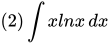
{\displaystyle (2)\int xlnx\,dx\,\!}
តាង
f
(
x
)
=
l
n
x
,
g
′
(
x
)
=
x
{\displaystyle \color {Red}f(x)=lnx,g'(x)=x}
គេបាន
∫
x
l
n
x
d
x
=
∫
l
n
x
(
1
2
x
2
)
′
d
x
=
l
n
x
(
1
2
x
2
)
−
∫
(
l
n
x
)
′
(
1
2
x
2
)
d
x
{\displaystyle \int xlnx\,dx\,\!=\int lnx({\frac {1}{2}}x^{2})'\,dx\,\!=lnx({\frac {1}{2}}x^{2})-\int (lnx)'({\frac {1}{2}}x^{2})\,dx\,\!}
=
1
2
x
2
l
n
x
−
1
2
∫
x
d
x
=
1
2
x
2
l
n
x
−
1
4
x
2
+
C
{\displaystyle ={\frac {1}{2}}x^{2}lnx-{\frac {1}{2}}\int x\,dx\,\!={\frac {1}{2}}x^{2}lnx-{\frac {1}{4}}x^{2}+C}
គេមានអនុគមន៏
φ
(
x
)
=
t
{\displaystyle \varphi (x)=t}
គេបាន
∫
f
(
φ
(
x
)
)
φ
′
(
x
)
d
x
=
∫
f
(
t
)
d
t
d
x
d
x
=
∫
f
(
t
)
d
t
{\displaystyle \color {blue}\int f(\varphi (x))\varphi '(x)\,dx\,\!=\int f(t){\frac {dt}{dx}}\,dx\,\!=\int f(t)\,dt\,\!}
ឧទាហរណ៏ៈគណនាអាំងតេក្រាល
(
1
)
∫
s
i
n
2
x
c
o
s
x
d
x
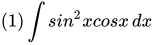
{\displaystyle (1)\int sin^{2}xcosx\,dx\,\!}
ឧទាហរណ៍
1
(
x
+
3
)
(
x
+
2
)
(
x
+
5
)
=
A
x
+
3
+
B
x
+
2
+
C
x
+
5
{\displaystyle {\frac {1}{(x+3)(x+2)(x+5)}}\,\!={\frac {A}{x+3}}\,\!+{\frac {B}{x+2}}\,\!+{\frac {C}{x+5}}\,\!}
តម្រូវភាគបែង រួចប្រៀបធៀបមេគុណរួមដឺក្រេនៃ
x
{\displaystyle x\!}
គុណអង្គទាំងពីរនឹង
x
+
3
{\displaystyle x+3\!}
រួចយក
x
=
−
3
{\displaystyle x=-3\!}
គេបាន
A
=
−
1
2
{\displaystyle A=-{\frac {1}{2}}\!}
គុណអង្គទាំងពីរនឹង
x
+
2
{\displaystyle x+2\!}
រួចយក
x
=
−
2
{\displaystyle x=-2\!}
គេបាន
B
=
1
3
{\displaystyle B={\frac {1}{3}}\!}
គុណអង្គទាំងពីរនឹង
x
+
5
{\displaystyle x+5\!}
រួចយក
x
=
−
5
{\displaystyle x=-5\!}
គេបាន
C
=
1
6
{\displaystyle C={\frac {1}{6}}\!}
ឧទាហរណ៍
x
2
+
1
(
x
+
1
)
(
x
−
2
)
(
x
+
7
)
=
A
x
+
1
+
B
x
−
2
+
C
x
+
7
{\displaystyle {\frac {x^{2}+1}{(x+1)(x-2)(x+7)}}\,\!={\frac {A}{x+1}}\,\!+{\frac {B}{x-2}}\,\!+{\frac {C}{x+7}}\,\!}
គុណអង្គទាំងពីរនឹង
x
+
1
{\displaystyle x+1\!}
រួចយក
x
=
−
1
{\displaystyle x=-1\!}
គេបាន
A
=
−
1
9
{\displaystyle A=-{\frac {1}{9}}\!}
គុណអង្គទាំងពីរនឹង
x
−
2
{\displaystyle x-2\!}
រួចយក
x
=
2
{\displaystyle x=2\!}
គេបាន
B
=
5
27
{\displaystyle B={\frac {5}{27}}\!}
គុណអង្គទាំងពីរនឹង
x
+
7
{\displaystyle x+7\!}
រួចយក
x
=
−
7
{\displaystyle x=-7\!}
គេបាន
C
=
25
27
{\displaystyle C={\frac {25}{27}}\!}
គ/ ករណីភាគបែងមានឫសលំដាប់ខ្ពស់
ឧទាហរណ៍
x
+
2
(
x
+
3
)
3
(
x
−
1
)
=
A
(
x
+
3
)
3
+
B
(
x
+
3
)
2
+
C
x
+
3
+
D
x
−
1
{\displaystyle {\frac {x+2}{(x+3)^{3}(x-1)}}\,\!={\frac {A}{(x+3)^{3}}}\,\!+{\frac {B}{(x+3)^{2}}}\,\!+{\frac {C}{x+3}}\,\!+{\frac {D}{x-1}}\,\!}
យក
x
=
0
{\displaystyle x=0\!}
គេបាន
B
=
−
3
16
{\displaystyle B=-{\frac {3}{16}}\,\!}
គុណអង្គទាំងពីរនឹង
(
x
+
3
)
3
{\displaystyle (x+3)^{3}\!}
រួចយក
x
=
−
3
{\displaystyle x=-3\!}
គេបាន
A
=
1
4
{\displaystyle A={\frac {1}{4}}\!}
គុណអង្គទាំងពីរនឹង
x
−
1
{\displaystyle x-1\!}
រួចយក
x
=
1
{\displaystyle x=1\!}
គេបាន
D
=
3
64
{\displaystyle D={\frac {3}{64}}\!}
គុណអង្គទាំងពីរនឹង
x
+
3
{\displaystyle x+3\!}
រួចយក
x
→
+
∞
{\displaystyle x\to +\infty \,\!}
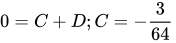
គេបាន
0
=
C
+
D
;
C
=
−
3
64
{\displaystyle 0=C+D;C=-{\frac {3}{64}}\,\!}
យក
x
=
0
{\displaystyle x=0\!}
គេបាន
B
=
−
3
16
{\displaystyle B=-{\frac {3}{16}}\,\!}
ឃ/ ករណីភាគបែងមានឫសកុំផ្លិច
ឧទាហរណ៍
x
+
1
(
x
−
2
)
(
x
2
+
1
)
=
A
x
−
2
+
B
x
+
C
x
2
+
1
{\displaystyle {\frac {x+1}{(x-2)(x^{2}+1)}}\,\!={\frac {A}{x-2}}\,\!+{\frac {Bx+C}{x^{2}+1}}\,\!}
គុណអង្គទាំង២ នឹង
x
−
2
{\displaystyle x-2\!}
គេបាន
A
=
3
5
{\displaystyle A={\frac {3}{5}}\,\!}
គុណអង្គទាំង២ នឹង
x
2
+
1
{\displaystyle x^{2}+1\!}
រួចយក
x
=
i
{\displaystyle x=i\!}
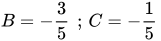
គេបាន
B
=
−
3
5
;
C
=
−
1
5
{\displaystyle B=-{\frac {3}{5}}\,\ ;\,C=-{\frac {1}{5}}\,\!}
ង/ ករណីភាគបែងមានឫសកុំផ្លិចលំដាប់ខ្ពស់
ឧទាហរណ៍

4
x
4
+
1
=
A
x
+
B
x
2
−
2
x
+
1
+
C
x
+
D
x
2
+
2
x
+
1
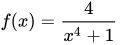
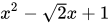
{\displaystyle {\frac {4}{x^{4}+1}}\,\!={\frac {Ax+B}{x^{2}-{\sqrt {2}}x+1}}\,\!+{\frac {Cx+D}{x^{2}+{\sqrt {2}}x+1}}\,\!}
ដោយ
f
(
x
)
=
4
x
4
+
1
{\displaystyle f(x)={\frac {4}{x^{4}+1}}\,\!}
ជាអនុគមន៍គូ គេបាន
A
x
+
B
x
2
−
2
x
+
1
+
C
x
+
D
x
2
+
2
x
+
1
=
−
A
x
+
B
x
2
+
2
x
+
1
+
−
C
x
+
D
x
2
−
2
x
+
1
{\displaystyle {\frac {Ax+B}{x^{2}-{\sqrt {2}}x+1}}\,\!+{\frac {Cx+D}{x^{2}+{\sqrt {2}}x+1}}\,\!={\frac {-Ax+B}{x^{2}+{\sqrt {2}}x+1}}\,\!+{\frac {-Cx+D}{x^{2}-{\sqrt {2}}x+1}}\,\!}
គេបាន
A
=
−
C
;
B
=
D
{\displaystyle A=-C\ ;\,B=D\!}
គុណអង្គទាំង២នឹង
x
2
−
2
x
+
1
{\displaystyle x^{2}-{\sqrt {2}}x+1\!}
រួចយក
x
=
i
{\displaystyle x=i\!}
គេបាន
A
=
−
2
;
C
=
2
{\displaystyle A=-{\sqrt {2}}\,\ ;\,C={\sqrt {2}}\!}
យក
x
=
0
{\displaystyle x=0\!}
គេបាន
B
=
D
=
2
{\displaystyle B=D=2\!}
វិធីសាស្រ្ត OSTROGRADSKI[ កែប្រែ ]
ប្រើសម្រាប់គណនាអាំងតេក្រាលអនុគមន៍ប្រភាគសនិទានដែលភាគបែងមានឫសលំដាប់ខ្ពស់ ។
បើ
P
(
x
)
Q
(
x
)
{\displaystyle {\frac {P(x)}{Q(x)}}\!}
មានឫសលំដាប់ខ្ពស់ច្រើន គេបាន៖
∫
P
(
x
)
Q
(
x
)
d
x
=
X
(
x
)
R
(
x
)
+
∫
Y
(
x
)
S
(
x
)
d
x
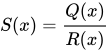
{\displaystyle \color {blue}\int {\frac {P(x)}{Q(x)}}\,dx\,\!={\frac {X(x)}{R(x)}}\,\!+\int {\frac {Y(x)}{S(x)}}\,dx\,\!}
ដែល
R
(
x
)
=
P
G
C
D
[
Q
(
x
)
;
Q
′
(
x
)
]
{\displaystyle R(x)=PGCD[Q(x);Q^{'}(x)]\!}
S
(
x
)
=
Q
(
x
)
R
(
x
)
{\displaystyle S(x)={\frac {Q(x)}{R(x)}}\!}
X
(
x
)
{\displaystyle X(x)\!}
និង
Y
(
x
)
{\displaystyle Y(x)\!}
ជាពហុធាមានមេគុណត្រូវកំណត់ហើយមានដឺក្រេរៀងគ្នា តូចជាង
R
(
x
)
{\displaystyle R(x)\!}
និង
S
(
x
)
{\displaystyle S(x)\!}
មួយឯកតា
ឧទាហរណ៍ : គណនា
I
=
∫
1
(
x
3
−
1
)
2
d
x
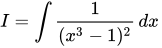
{\displaystyle I=\int {\frac {1}{(x^{3}-1)^{2}}}\,dx\,\!}
1
(
x
3
−
1
)
2
=
1
(
x
−
1
)
2
(
x
2
+
x
+
1
)
2
=
A
(
x
−
1
)
2
+
B
x
−
1
+
C
x
+
D
(
x
2
+
x
+
1
)
2
+
E
x
+
F
x
2
+
x
+
1
{\displaystyle {\frac {1}{(x^{3}-1)^{2}}}\,\!={\frac {1}{(x-1)^{2}(x^{2}+x+1)^{2}}}\,\!={\frac {A}{(x-1)^{2}}}\,\!+{\frac {B}{x-1}}\,\!+{\frac {Cx+D}{(x^{2}+x+1)^{2}}}\,\!+{\frac {Ex+F}{x^{2}+x+1}}\,\!}
គេបាន
Q
(
x
)
=
(
x
3
−
1
)
2
;
Q
′
(
x
)
=
6
x
2
(
x
3
−
1
)
;
R
(
x
)
=
P
G
C
D
[
Q
(
x
)
;
Q
′
(
x
)
]
=
x
3
−
1
;
S
(
x
)
=
Q
(
x
)
R
(
x
)
=
(
x
3
−
1
)
2
x
3
−
1
=
x
3
−
1
{\displaystyle Q(x)=(x^{3}-1)^{2};Q^{'}(x)=6x^{2}(x^{3}-1);R(x)=PGCD[Q(x);Q^{'}(x)]=x^{3}-1;S(x)={\frac {Q(x)}{R(x)}}\,\!={\frac {(x^{3}-1)^{2}}{x^{3}-1}}\,\!=x^{3}-1\!}
⇒
I
=
∫
1
(
x
3
−
1
)
2
d
x
=
a
x
2
+
b
x
+
c
x
3
−
1
+
∫
a
′
x
2
+
b
′
x
+
c
′
x
3
−
1
d
x
{\displaystyle \Rightarrow I=\int {\frac {1}{(x^{3}-1)^{2}}}\,dx\,\!={\frac {ax^{2}+bx+c}{x^{3}-1}}\,\!+\int {\frac {a^{'}x^{2}+b^{'}x+c^{'}}{x^{3}-1}}\,dx\,\!}
ដេរីវេ អង្គទាំង២ គេបាន
1
(
x
3
−
1
)
2
=
(
2
a
x
+
b
)
(
x
3
−
1
)
−
3
x
2
(
a
x
2
+
b
x
+
c
)
(
x
3
−
1
)
2
+
(
a
′
x
2
+
b
′
x
+
c
′
)
(
x
3
−
1
)
(
x
3
−
1
)
2
{\displaystyle {\frac {1}{(x^{3}-1)^{2}}}\,\!={\frac {(2ax+b)(x^{3}-1)-3x^{2}(ax^{2}+bx+c)}{(x^{3}-1)^{2}}}\,\!+{\frac {(a^{'}x^{2}+b^{'}x+c^{'})(x^{3}-1)}{(x^{3}-1)^{2}}}\,\!}
តម្រូវភាគបែង រួចប្រៀបធៀបមេគុណរួមដឺក្រេនៃ
x
{\displaystyle x\!}
គេបាន
a
=
0
;
b
=
−
1
3
;
c
=
0
;
a
′
=
0
;
b
′
=
0
;
c
′
=
−
2
3
{\displaystyle a=0;b=-{\frac {1}{3}}\,\!;c=0;a^{'}=0;b^{'}=0;c^{'}=-{\frac {2}{3}}\!}
⇒
I
=
∫
1
(
x
3
−
1
)
2
d
x
=
−
1
3
x
x
3
−
1
+
∫
−
2
3
x
3
−
1
d
x
{\displaystyle \Rightarrow I=\int {\frac {1}{(x^{3}-1)^{2}}}\,dx\,\!={\frac {-{\frac {1}{3}}\,\!x}{x^{3}-1}}\,\!+\int {\frac {-{\frac {2}{3}}\,\!}{x^{3}-1}}\,dx\,\!}
អាំងតេក្រាលអនុគមន៍អសនិទាន[ កែប្រែ ]
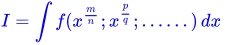
I
=
∫
f
(
x
m
n
;
x
p
q
;
.
.
.
.
.
.
)
d
x
{\displaystyle \color {blue}I=\int f(x^{\frac {m}{n}}\,\!;x^{\frac {p}{q}}\,\!;......)\,dx\,\!}
គេត្រូវតាង
x
=
t
k
{\displaystyle x=t^{k}\!}
ដែល
k
{\displaystyle k\!}
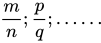
ជាភាគបែងរួមនៃប្រភាគ
m
n
;
p
q
;
.
.
.
.
.
.
{\displaystyle {\frac {m}{n}}\,\!;{\frac {p}{q}}\,\!;......\!}
ឧទាហរណ៍ : គណនា
I
=
∫
x
3
x
+
x
4
d
x
=
∫
x
1
3
x
1
2
+
x
1
4
{\displaystyle I=\int {\frac {\sqrt[{3}]{x}}{{\sqrt {x}}\,\!+{\sqrt[{4}]{x}}}}\,dx\,\!=\int {\frac {x^{\frac {1}{3}}}{x^{\frac {1}{2}}\,\!+x^{\frac {1}{4}}}}\,\!}
តាង
x
=
t
12
{\displaystyle x=t^{12}\!}
I
=
∫
f
[
(
a
x
+
b
c
x
+
d
)
m
n
;
(
a
x
+
b
c
x
+
d
)
p
q
;
.
.
.
.
.
.
]
d
x
{\displaystyle \color {blue}I=\int f\left[\left({\frac {ax+b}{cx+d}}\,\!\right)^{\frac {m}{n}}\,\!;\left({\frac {ax+b}{cx+d}}\,\!\right)^{\frac {p}{q}}\,\!;......\right]\,dx\,\!}
គេតាង
a
x
+
b
c
x
+
d
=
t
k
{\displaystyle {\frac {ax+b}{cx+d}}\,\!=t^{k}\!}
ដែល
k
{\displaystyle k\!}
ជាភាគបែងរួមនៃប្រភាគ
m
n
;
p
q
;
.
.
.
.
.
.
{\displaystyle {\frac {m}{n}}\,\!;{\frac {p}{q}}\,\!;......\!}
ឧទាហរណ៍ : គណនា
I
=
∫
1
−
x
1
+
x
d
x
=
∫
(
1
−
x
1
+
x
)
1
2
d
x
{\displaystyle I=\int {\sqrt {\frac {1-x}{1+x}}}\,dx\,\!=\int \left({\frac {1-x}{1+x}}\right)^{\frac {1}{2}}\,dx\,\!}
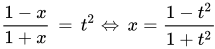
តាង
1
−
x
1
+
x
=
t
2
⇔
x
=
1
−
t
2
1
+
t
2
{\displaystyle {\frac {1-x}{1+x}}\,=\,t^{2}\,\!\Leftrightarrow \,x={\frac {1-t^{2}}{1+t^{2}}}\!}
វិធីសាស្រ្តប្តូរអថេរEULER[ កែប្រែ ]
សម្រាប់អាំងតេក្រាលមានរាង
I
=
∫
f
(
x
;
a
x
2
+
b
x
+
c
)
d
x
{\displaystyle \color {blue}I=\int f\left(x;{\sqrt {ax^{2}+bx+c}}\right)\,dx\,\!}
ក/ បើ Δ<0 ; a>0 តាង
a
x
2
+
b
x
+
c
=
a
x
+
t
{\displaystyle {\sqrt {ax^{2}+bx+c}}\,=\,{\sqrt {a}}x+t\!}
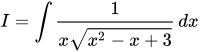
ឧទាហរណ៍ : គណនា
I
=
∫
1
x
x
2
−
x
+
3
d
x
{\displaystyle I=\int {\frac {1}{x{\sqrt {x^{2}-x+3}}}}\,dx\,\!}
តាង
x
2
−
x
+
3
=
x
+
t
⇒
x
=
3
−
t
2
1
+
2
t
{\displaystyle {\sqrt {x^{2}-x+3}}\,=\,x+t\,\Rightarrow x={\frac {3-t^{2}}{1+2t}}\,\!}
ខ/ បើ Δ<0 ; c >0 តាង
a
x
2
+
b
x
+
c
=
x
t
+
c
{\displaystyle {\sqrt {ax^{2}+bx+c}}\,=\,xt+{\sqrt {c}}\!}
ឧទាហរណ៍ : គណនា
I
=
∫
(
1
−
1
+
x
+
x
2
)
2
x
2
1
+
x
+
x
2
d
x
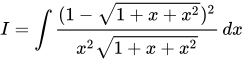
{\displaystyle I=\int {\frac {(1-{\sqrt {1+x+x^{2}}})^{2}}{x^{2}{\sqrt {1+x+x^{2}}}}}\,dx\,\!}
តាង
1
+
x
+
x
2
=
x
t
+
1
⇒
x
=
1
−
2
t
t
2
−
1
{\displaystyle {\sqrt {1+x+x^{2}}}\,=\,xt+1\Rightarrow x={\frac {1-2t}{t^{2}-1}}\,\!}
គ/ បើ Δ>0 គេបាន
a
x
2
+
b
x
+
c
=
a
(
x
−
x
1
)
(
x
−
x
2
)
{\displaystyle {\sqrt {ax^{2}+bx+c}}\,=\,{\sqrt {a(x-x_{1})(x-x_{2})}}\,\!}
ឧទាហរណ៍ : គណនា
I
=
∫
x
2
+
2
x
x
d
x
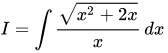
{\displaystyle I=\int {\frac {\sqrt {x^{2}+2x}}{x}}\,dx\,\!}
តាង
x
2
+
2
x
=
x
t
⇒
x
=
2
t
2
−
1
{\displaystyle {\sqrt {x^{2}+2x}}\,=\,xt\Rightarrow x={\frac {2}{t^{2}-1}}\,\!}
អាំងតេក្រាលរាង
I
=
∫
P
n
(
x
)
a
x
2
+
b
x
+
c
d
x
{\displaystyle \color {blue}I=\int {\frac {P_{n}(x)}{\sqrt {ax^{2}+bx+c}}}\,dx\,\!}
[ កែប្រែ ]
គេបំលែង
I
=
∫
P
n
(
x
)
a
x
2
+
b
x
+
c
d
x
=
P
n
−
1
(
x
)
a
x
2
+
b
x
+
c
+
λ
∫
1
a
x
2
+
b
x
+
c
d
x
{\displaystyle \color {Red}I=\int {\frac {P_{n}(x)}{\sqrt {ax^{2}+bx+c}}}\,dx\,=\,P_{n-1}(x){\sqrt {ax^{2}+bx+c}}\,+\,\lambda \int {\frac {1}{\sqrt {ax^{2}+bx+c}}}\,dx\,\!}
P
n
−
1
(
x
)
{\displaystyle P_{n-1}(x)\!}
ជាពហុធាដឺក្រេ
n
−
1
{\displaystyle n-1\!}
មានមេគុណត្រូវកំណត់ ហើយគេអាចគណនាមេគុណទាំងនោះ ដោយដេរីវេអង្គទាំងពីរ រួចប្រៀបធៀមេគុណរួមដឺក្ររេនៃះ
x
{\displaystyle x\!}
។
ឧទាហរណ៍ : គណនា
I
=
∫
x
3
+
2
x
2
+
3
x
+
4
x
2
+
2
x
+
2
d
x
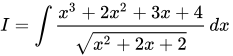
{\displaystyle I=\int {\frac {x^{3}+2x^{2}+3x+4}{\sqrt {x^{2}+2x+2}}}\,dx\,\!}
គេបាន :
I
=
∫
x
3
+
2
x
2
+
3
x
+
4
x
2
+
2
x
+
2
d
x
=
(
a
x
2
+
b
x
+
c
)
x
2
+
2
x
+
2
+
λ
∫
1
x
2
+
2
x
+
2
d
x
{\displaystyle I=\int {\frac {x^{3}+2x^{2}+3x+4}{\sqrt {x^{2}+2x+2}}}\,dx\,=\,(ax^{2}+bx+c){\sqrt {x^{2}+2x+2}}\,+\,\lambda \int {\frac {1}{\sqrt {x^{2}+2x+2}}}\,dx\,\!}
អាំងតេក្រាលអនុគមន៍ទ្វេធាឌីផេរ៉ង់ស្យែល[ កែប្រែ ]
I
=
∫
x
m
(
a
+
b
x
n
)
p
d
x
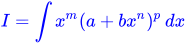
{\displaystyle \color {blue}I=\int x^{m}(a+bx^{n})^{p}\,dx\,\!}
គេអាចគណនាតាមបីករណី៖
បើ
p
∈
Z
{\displaystyle p\in \mathbb {Z} \!}
តាង
x
=
t
k
{\displaystyle x=t^{k}\!}
ដែល
k
{\displaystyle k\!}
ជាភាគបែងរួមនៃប្រភាគ
m
;
n
{\displaystyle m;n\!}
ឧទាហរណ៍ : គណនា
I
=
∫
1
x
(
x
4
+
1
)
10
d
x
=
∫
x
−
1
2
(
x
1
4
+
1
)
−
10
d
x
{\displaystyle I=\int {\frac {1}{{\sqrt {x}}({\sqrt[{4}]{x}}+1)^{10}}}\,dx\,=\,\int x^{-{\frac {1}{2}}}(x^{\frac {1}{4}}+1)^{-10}\,dx\,\!}
តាង
x
=
t
4
{\displaystyle x=t^{4}\!}
បើ
p
∉
Z
;
m
+
1
n
∈
Z
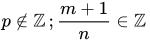
{\displaystyle p\not \in \mathbb {Z} \,;{\frac {m+1}{n}}\in \mathbb {Z} \,\!}
តាង
a
+
b
x
n
=
t
k
;
k
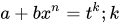
{\displaystyle a+bx^{n}=t^{k};k\!}
ជាភាគបែងរួមនៃ
p
{\displaystyle p\!}
ឧទាហរណ៍ : គណនា
I
=
∫
1
+
x
4
3
x
d
x
=
∫
x
−
1
2
(
1
+
x
1
4
)
1
3
d
x
{\displaystyle I=\int {\frac {\sqrt[{3}]{1+{\sqrt[{4}]{x}}}}{\sqrt {x}}}\,dx\,=\,\int x^{-{\frac {1}{2}}}(1+x^{\frac {1}{4}})^{\frac {1}{3}}\,dx\,\!}
តាង
1
+
x
1
4
=
t
3
⇔
x
=
(
t
3
−
1
)
4
{\displaystyle 1+x^{\frac {1}{4}}=t^{3}\,\Leftrightarrow x=(t^{3}-1)^{4}\,\!}
បើ
p
∉
Z
;
m
+
1
n
∉
Z
;
m
+
1
n
+
p
∈
Z
{\displaystyle p\not \in \mathbb {Z} \,;{\frac {m+1}{n}}\not \in \mathbb {Z} \,;{\frac {m+1}{n}}+p\in \mathbb {Z} \,\!}
តាង
a
+
b
x
−
n
=
t
k
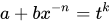
{\displaystyle a+bx^{-n}=t^{k}\!}
ឬ
a
+
b
x
n
x
m
{\displaystyle {\frac {a+bx^{n}}{x^{m}}}\!}
ដែល
k
{\displaystyle k\!}
ជាភាគបែងរួមនៃ
p
{\displaystyle p\!}
ឧទាហរណ៍ : គណនា
∫
1
x
4
1
+
x
2
d
x
=
∫
x
−
4
(
1
+
x
2
)
−
1
2
d
x
{\displaystyle \int {\frac {1}{x^{4}{\sqrt {1+x^{2}}}}}\,dx\,=\,\int x^{-4}(1+x^{2})^{-{\frac {1}{2}}}\,dx\,\!}
តាង
1
+
x
−
2
=
t
2
⇔
x
=
(
t
2
−
1
)
−
1
2
{\displaystyle 1+x^{-2}=t^{2}\,\Leftrightarrow x=(t^{2}-1)^{-{\frac {1}{2}}}\,\!}
អាំងតេក្រាលដោយផ្នែកដែលមាន៤រាង[ កែប្រែ ]
ប្រើរូបមន្តអាំងតេក្រាលដោយផ្នែក
∫
u
d
v
=
u
v
−
∫
v
d
u
{\displaystyle \int udv\,=\,uv\,-\,\int vdu\!}
១/ រាង
∫
P
(
x
)
s
i
n
a
x
d
x
;
∫
P
(
x
)
c
o
s
a
x
d
x
;
∫
P
(
x
)
e
a
x
d
x
{\displaystyle \color {blue}\int P(x)sinaxdx\,;\,\int P(x)cosaxdx\,;\,\int P(x)e^{ax}dx\,\!}
ដែល
P
(
x
)
{\displaystyle P(x)\!}
ជាពហុធា
;
a
{\displaystyle ;\,a}
ជាចំនួនថេរ គេតាង
u
=
P
(
x
)
{\displaystyle u=P(x)\!}
ឧទាហរណ៍ : គណនា
∫
x
s
i
n
2
x
d
x
{\displaystyle \int xsin2xdx\!}
តាង
u
=
x
⇒
d
u
=
d
x
{\displaystyle u=x\Rightarrow du=dx\!}
២/ រាង
∫
P
(
x
)
l
o
g
a
x
d
x
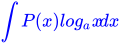
{\displaystyle \color {blue}\int P(x)log_{a}x\!dx}
តាង
u
=
l
o
g
a
x
{\displaystyle u=log_{a}x\!}
ឧទាហរណ៍ : គណនា
∫
x
2
l
o
g
2
x
d
x
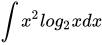
{\displaystyle \int x^{2}log_{2}xdx\!}
តាង
u
=
l
o
g
2
x
{\displaystyle u=log_{2}x\!}
៣/ រាង
∫
e
a
x
s
i
n
a
x
d
x
;
∫
e
a
x
c
o
s
a
x
d
x
{\displaystyle \color {blue}\int e^{ax}sinaxdx\,;\,\int e^{ax}cosaxdx\!}
តាង
u
=
e
a
x
{\displaystyle u=e^{ax}\!}
ឧទាហរណ៍ : គណនា
∫
e
x
c
o
s
3
x
d
x
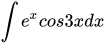
{\displaystyle \int e^{x}cos3xdx\!}
តាង
u
=
e
x
{\displaystyle u=e^{x}\!}
៤/ រាង
∫
P
(
x
)
a
r
c
s
i
n
x
d
x
;
∫
P
(
x
)
a
r
c
c
o
s
x
d
x
;
∫
P
(
x
)
a
r
c
t
a
n
x
d
x
{\displaystyle \color {blue}\int P(x)arcsinxdx\ ;\,\int P(x)arccosxdx\,;\,\int P(x)arctanxdx\!}
តាង
u
=
a
r
c
s
i
n
x
;
u
=
a
r
c
c
o
s
x
;
u
=
a
r
c
t
a
n
x
{\displaystyle u=arcsinx\,;\,u=arccosx\,;u=arctanx\!}
ឧទាហរណ៍ : គណនា
∫
x
a
r
c
t
a
n
x
d
x
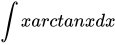
{\displaystyle \int xarctanxdx\!}
តាង
u
=
a
r
c
t
a
n
x
⇒
d
u
=
1
1
+
x
2
d
x
{\displaystyle u=arctanx\Rightarrow \,du={\frac {1}{1+x^{2}}}\,dx\,\!}
៥/ រាង
∫
c
o
s
m
x
c
o
s
n
x
d
x
;
∫
s
i
n
m
x
s
i
n
n
x
d
x
;
∫
s
i
n
m
x
c
o
s
n
x
d
x
{\displaystyle \color {blue}\int cosmxcosnxdx\,;\,\int sinmxsinnxdx\,;\,\int sinmxcosnxdx\!}
ប្រើរូបមន្ត នូឌុប
c
o
s
a
c
o
s
b
=
1
2
[
c
o
s
(
a
+
b
)
+
c
o
s
(
a
−
b
)
]
{\displaystyle cosacosb\,=\,{\frac {1}{2}}[cos(a+b)+cos(a-b)]\!}
s
i
n
a
s
i
n
b
=
1
2
[
c
o
s
(
a
−
b
)
−
c
o
s
(
a
+
b
)
]
{\displaystyle sinasinb\,=\,{\frac {1}{2}}[cos(a-b)-cos(a+b)]\!}
s
i
n
a
c
o
s
b
=
1
2
[
s
i
n
(
a
+
b
)
+
s
i
n
(
a
−
b
)
]
{\displaystyle sinacosb\,=\,{\frac {1}{2}}[sin(a+b)+sin(a-b)]\!}
ឧទាហរណ៍ : គណនា
∫
s
i
n
4
x
s
i
n
3
x
d
x
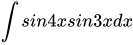
{\displaystyle \int sin4xsin3xdx\!}
អាំងតេក្រាលរាង
I
=
∫
s
i
n
m
x
c
o
s
n
x
d
x
;
(
m
<
0
;
n
<
0
)
{\displaystyle \color {blue}I=\int sin^{m}xcos^{n}xdx\,;\,(m<0;n<0)\!}
[ កែប្រែ ]
គេតាង
t
=
t
a
n
x
⇒
d
t
=
(
1
+
t
a
n
2
x
)
d
x
⇔
d
x
=
1
1
+
t
2
d
t
{\displaystyle t=tanx\Rightarrow \,dt=(1+tan^{2}x)dx\,\Leftrightarrow dx={\frac {1}{1+t^{2}}}\,dt\!}
ឧទាហរណ៍ : គណនា
I
=
∫
s
i
n
−
3
2
x
c
o
s
−
1
x
d
x
=
∫
1
s
i
n
3
2
c
o
s
x
d
x
{\displaystyle I=\int sin^{-{\frac {3}{2}}}xcos^{-1}xdx\,=\,\int {\frac {1}{sin^{\frac {3}{2}}cosx}}\,dx\,\!}
បំលែង
1
s
i
n
3
2
c
o
s
x
=
(
1
+
1
t
a
n
2
x
)
3
4
(
1
+
t
a
n
2
)
1
2
{\displaystyle {\frac {1}{sin^{{\frac {3}{2}}{cosx}}}}\,=\,(1+{\frac {1}{tan^{2}x}})^{\frac {3}{4}}(1+tan^{2})^{\frac {1}{2}}\!}
តាង
t
=
t
a
n
x
⇔
d
x
=
1
1
+
t
2
d
t
{\displaystyle t=tanx\,\Leftrightarrow dx={\frac {1}{1+t^{2}}}\,dt\,\!}
គេបាន
I
=
∫
t
−
3
2
(
1
+
t
2
)
1
4
d
t
{\displaystyle I=\int t^{-{\frac {3}{2}}}(1+t^{2})^{\frac {1}{4}}\,dt\!}
តាង
1
+
t
−
2
=
k
4
{\displaystyle 1+t^{-2}=k^{4}\!}
អាំងតេក្រាលរាង
I
=
∫
t
a
n
m
x
d
x
;
J
=
∫
c
o
t
n
x
d
x
{\displaystyle \color {blue}I=\int tan^{m}xdx\ ;\,J=\int cot^{n}xdx\!}
[ កែប្រែ ]
គេប្រើវីធីបន្ថយដឺក្រេ
ឧទាហរណ៍ : គណនា
I
=
∫
t
a
n
5
x
d
x
=
∫
t
a
n
3
x
t
a
n
2
x
d
x
=
∫
[
t
a
n
3
x
(
t
a
n
2
x
+
1
)
−
t
a
n
3
x
]
d
x
{\displaystyle I=\int tan^{5}xdx\,=\,\int tan^{3}xtan^{2}xdx\,=\,\int [tan^{3}x(tan^{2}x+1)-tan^{3}x]dx\!}
អាំងតេក្រាលអនុគមន៍ត្រីកោណមាត្រ
I
=
∫
R
(
s
i
n
x
;
c
o
s
x
)
d
x
{\displaystyle \color {blue}I=\int R(sinx\,;\,cosx)\,dx\,\!}
[ កែប្រែ ]
ជាទូទៅ គេតាង
t
=
t
a
n
x
2
⇒
x
=
2
a
r
c
t
a
n
t
⇒
d
x
=
2
1
+
t
2
d
t
{\displaystyle t=tan{\frac {x}{2}}\Rightarrow x=2arctant\Rightarrow dx={\frac {2}{1+t^{2}}}dt\!}
s
i
n
x
=
2
t
1
+
t
2
;
c
o
s
x
=
1
−
t
2
1
+
t
2
;
t
a
n
x
=
2
t
1
−
t
2
{\displaystyle sinx={\frac {2t}{1+t^{2}}}\,;\,cosx={\frac {1-t^{2}}{1+t^{2}}}\,;\,tanx={\frac {2t}{1-t^{2}}}\!}
ឧទាហរណ៍ : គណនា
I
=
∫
1
1
+
s
i
n
x
d
x
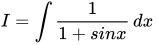
{\displaystyle I=\int {\frac {1}{1+sinx}}\,dx\,\!}
តាង
t
=
t
a
n
x
2
{\displaystyle t=tan{\frac {x}{2}}\!}
ក/ បើ
R
(
−
s
i
n
x
;
c
o
s
x
)
=
−
R
(
s
i
n
x
;
c
o
s
x
)
{\displaystyle \color {blue}R(-sinx;cosx)=-R(sinx;cosx)\!}
តាង
t
=
c
o
s
x
{\displaystyle t=cosx\!}
ឧទាហរណ៍ : គណនា
I
=
∫
s
i
n
3
x
c
o
s
x
+
s
i
n
2
x
+
1
d
x
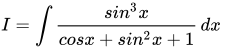
{\displaystyle I=\int {\frac {sin^{3}x}{cosx+sin^{2}x+1}}\,dx\,\!}
t
=
c
o
s
x
⇒
d
t
=
−
s
i
n
x
d
x
{\displaystyle t=cosx\Rightarrow dt=-sinxdx\!}
ខ/ បើ
R
(
s
i
n
x
;
−
c
o
s
x
)
=
−
R
(
s
i
n
x
;
c
o
s
x
)
{\displaystyle \color {blue}R(sinx;-cosx)=-R(sinx;cosx)\!}
តាង
t
=
s
i
n
x
{\displaystyle t=sinx\!}
ឧទាហរណ៍ : គណនា
I
=
∫
c
o
s
5
x
s
i
n
3
x
+
c
o
s
2
x
−
s
i
n
x
d
x
{\displaystyle I=\int {\frac {cos^{5}x}{sin^{3}x+cos^{2}x-sinx}}\,dx\,\!}
t
=
s
i
n
x
⇒
d
t
=
c
o
s
x
d
x
{\displaystyle t=sinx\Rightarrow dt=cosxdx\!}
គ/ បើ
R
(
−
s
i
n
x
;
−
c
o
s
x
)
=
R
(
s
i
n
x
;
c
o
s
x
)
{\displaystyle \color {blue}R(-sinx;-cosx)=R(sinx;cosx)\!}
តាង
t
=
t
a
n
x
⇒
x
=
a
r
c
t
a
n
t
⇒
d
x
=
1
1
+
t
2
d
t
{\displaystyle t=tanx\Rightarrow x=arctant\Rightarrow dx={\frac {1}{1+t^{2}}}dt\!}
ឧទាហរណ៍ : គណនា
I
=
∫
c
o
s
2
x
s
i
n
2
x
+
4
s
i
n
x
c
o
s
x
d
x
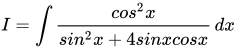
{\displaystyle I=\int {\frac {cos^{2}x}{sin^{2}x+4sinxcosx}}\,dx\,\!}
តាង
t
=
t
a
n
x
{\displaystyle t=tanx\!}
វិធីប្តូរអថេរត្រីកោណមាត្រ[ កែប្រែ ]
ក/ បើអនុគមន៍ក្រោមសញ្ញាអាំងតេក្រាលមានរ៉ាឌីកាល់
a
2
−
x
2
{\displaystyle {\sqrt {a^{2}-x^{2}}}\!}
គេត្រូវ តាង
x
=
a
c
o
s
t
{\displaystyle x=acost\!}
ឬ
x
=
a
s
i
n
t
{\displaystyle x=asint\!}
ឧទាហរណ៍ : គណនា
I
=
∫
2
−
x
2
d
x
=
∫
2
2
−
x
2
d
x
{\displaystyle I=\int {\sqrt {2-x^{2}}}\,dx\,=\,\int {\sqrt {{\sqrt {2^{2}}}-x^{2}}}\,dx\,\!}
តាង
x
=
2
s
i
n
t
⇒
d
x
=
2
c
o
s
t
d
t
;
t
=
a
r
c
s
i
n
x
2
{\displaystyle x={\sqrt {2}}sint\Rightarrow dx={\sqrt {2}}costdt\,;\,t=arcsin{\frac {x}{\sqrt {2}}}\!}
ខ/ បើអនុគមន៍ក្រោមសញ្ញាអាំងតេក្រាលមានរ៉ាឌីកាល់
x
2
−
a
2
{\displaystyle {\sqrt {x^{2}-a^{2}}}\!}
គេត្រូវតាង
x
=
a
c
o
s
t
{\displaystyle x={\frac {a}{cost}}\!}
ឬ
x
=
a
s
i
n
t
{\displaystyle x={\frac {a}{sint}}\!}
ឧទាហរណ៍ : គណនា
I
=
∫
x
3
x
2
−
4
d
x
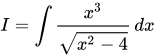
{\displaystyle I=\int {\frac {x^{3}}{\sqrt {x^{2}-4}}}\,dx\,\!}
តាង
x
=
2
c
o
s
t
⇒
d
x
=
2
s
i
n
t
c
o
s
2
t
d
t
;
t
=
a
r
c
c
o
s
2
x
{\displaystyle x={\frac {2}{cost}}\Rightarrow dx={\frac {2sint}{cos^{2}t}}dt\,;\ t=arccos{\frac {2}{x}}\!}
អាំងតេក្រាលរាង
I
=
∫
a
′
s
i
n
x
+
b
′
c
o
s
x
+
c
′
a
s
i
n
x
+
b
c
o
s
x
+
c
d
x
{\displaystyle \color {Blue}I=\int {\frac {a^{'}sinx+b^{'}cosx+c^{'}}{asinx+bcosx+c}}\,dx\,\!}
[ កែប្រែ ]
គេត្រូវបំលែង
a
′
s
i
n
x
+
b
′
c
o
s
x
+
c
′
=
A
(
a
s
i
n
x
+
b
c
o
s
x
+
c
)
+
B
(
a
c
o
s
x
−
b
s
i
n
x
)
+
C
{\displaystyle \color {Red}a^{'}sinx+b^{'}cosx+c^{'}\,=\,A(asinx+bcosx+c)+B(acosx-bsinx)+C\!}
ឧទាហរណ៍ : គណនា
I
=
∫
s
i
n
x
−
2
c
o
s
x
+
3
s
i
n
x
+
2
c
o
s
x
−
3
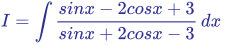
d
x
{\displaystyle \color {Blue}I=\int {\frac {sinx-2cosx+3}{sinx+2cosx-3}}\,dx\,\!}
ដោយ
s
i
n
x
−
2
c
o
s
x
+
3
=
A
(
s
i
n
x
+
2
c
o
s
x
−
3
)
+
B
(
c
o
s
x
−
2
s
i
n
x
)
+
C
=
(
A
−
2
B
)
s
i
n
x
+
(
2
A
+
B
)
c
o
s
x
−
3
A
+
C
{\displaystyle sinx-2cosx+3\,=\,A(sinx+2cosx-3)+B(cosx-2sinx)+C\,=\,(A-2B)sinx+(2A+B)cosx-3A+C\!}
គេបាន
A
=
−
3
5
;
B
=
−
4
5
;
C
=
6
5
{\displaystyle A=-{\frac {3}{5}}\,;\,B=-{\frac {4}{5}}\,;\,C={\frac {6}{5}}\!}
អាំតេក្រាលរាង
I
=
∫
a
′
s
i
n
2
x
+
2
b
′
s
i
n
x
c
o
s
x
+
c
′
c
o
s
2
x
a
s
i
n
x
+
b
c
o
s
x
d
x
{\displaystyle \color {blue}I=\int {\frac {a^{'}sin^{2}x+2b^{'}sinxcosx+c^{'}cos^{2}x}{asinx+bcosx}}\,dx\,\!}
[ កែប្រែ ]
គេត្រូវបំលែង
a
′
s
i
n
2
x
+
2
b
′
s
i
n
x
c
o
s
x
+
c
′
c
o
s
2
x
=
(
a
s
i
n
x
+
b
c
o
s
x
)
(
A
s
i
n
x
+
B
c
o
s
x
)
+
C
(
s
i
n
2
x
+
c
o
s
2
x
)
{\displaystyle \color {Red}a^{'}sin^{2}x+2b^{'}sinxcosx+c^{'}cos^{2}x\,=\,(asinx+bcosx)(Asinx+Bcosx)+C(sin^{2}x+cos^{2}x)\!}
ឧទាហរណ៍ : គណនា
I
=
∫
s
i
n
2
x
−
2
s
i
n
x
c
o
s
x
+
3
c
o
s
2
x
s
i
n
x
−
c
o
s
x
d
x
{\displaystyle I=\int {\frac {sin^{2}x-2sinxcosx+3cos^{2}x}{sinx-cosx}}\,dx\,\!}
ដោយ
s
i
n
2
x
−
2
s
i
n
x
c
o
s
x
+
3
c
o
s
2
x
=
(
s
i
n
x
−
c
o
s
x
)
(
A
s
i
n
x
+
B
c
o
s
x
)
+
C
(
s
i
n
2
x
+
c
o
s
2
x
)
=
(
A
+
C
)
s
i
n
2
x
+
(
B
−
A
)
s
i
n
x
c
o
s
x
+
(
C
−
B
)
c
o
s
2
x
{\displaystyle sin^{2}x-2sinxcosx+3cos^{2}x\,=\,(sinx-cosx)(Asinx+Bcosx)+C(sin^{2}x+cos^{2}x)\,=\,(A+C)sin^{2}x+(B-A)sinxcosx+(C-B)cos^{2}x\!}
គេបាន
A
=
0
;
B
=
−
2
;
C
=
1
{\displaystyle A=0\,;\,B=-2\,;\,C=1\!}
↑ Viray An. (1998) The Orkida Dictionary Of English-Cambodia Language. Cite error: Invalid parameter "name"intergral"" in <ref> tag. The supported parameters are: dir, follow, group, name.